
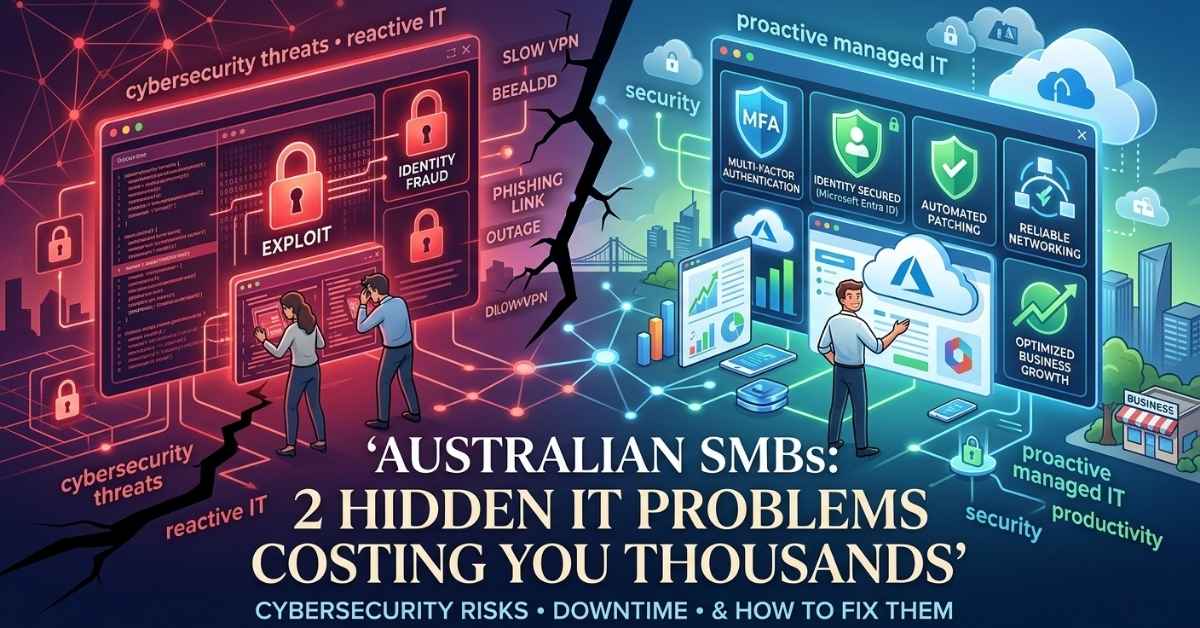
The Two IT Problems Quietly Costing Australian SMBs Thousands (And How to Fix Them)
Every six minutes, an Australian business reports a cybercrime to the Australian Signals Directorate’s Cyber Security Centre (ACSC). If your business doesn’t have someone actively watching your systems, the question isn’t if you’ll be targeted — it’s when, and how prepared you’ll be when it happens.
For small and medium businesses, IT problems rarely arrive as one dramatic event. More often, they’re a slow leak: a staff member clicking a convincing phishing link, a Friday-afternoon outage that swallows a day’s productivity, a VPN connection that drops every time someone tries to work from home. On their own, these incidents feel manageable. Added up over a year, they’re often the single biggest drag on profitability that nobody actually budgeted for.
Two problems come up again and again when we talk to SMBs about their IT. Here’s what they are, and what genuinely fixes them.
Problem 1: Cybersecurity Has Outgrown the “We’re Too Small to Be a Target” Mindset
It’s one of the most persistent myths in small business — the idea that cybercriminals only go after large corporations with deep pockets. The data tells a different story. According to the ASD’s Annual Cyber Threat Report for 2024–25, the ACSC received 84,700 cybercrime reports over the year, and responded to more than 1,200 serious incidents, an 11% increase on the year before. Small businesses reported average losses of $56,600 per incident, up 14% on the previous year.
The reason small businesses are attractive targets isn’t mystery — it’s math. Cybercriminals increasingly use automated tools to scan thousands of businesses at once, looking for the easy wins: outdated software, no multi-factor authentication, and staff who haven’t been trained to spot a fake invoice. The most commonly reported attack types were email compromise used for reconnaissance, business email compromise resulting in financial loss through fake invoices or redirected payments, and identity fraud using stolen credentials to gain further access.
That last one — identity fraud — is the crack that managed identity tools are specifically designed to close. A modern identity platform like Microsoft Entra ID lets a business enforce multi-factor authentication across every account, apply conditional access rules that block logins from suspicious locations or unmanaged devices, and get visibility into who is accessing what, from where. For a small business with no in-house security team, this is the difference between an attempted breach being blocked automatically and a six-figure recovery bill.
Problem 2: Downtime and Disjointed Cloud Systems Are Quietly Costing You
The second problem is less dramatic than a cyberattack but arguably more constant: things just don’t work as reliably as they should. Industry research from Datto found that 78% of SMBs say a single hour of downtime costs them more than $10,000 once lost productivity, missed sales, and recovery time are factored in. Separate industry analysis points to security incidents and human error as the leading causes of downtime, followed closely by outdated hardware, unsupported software, and simply not having enough IT support to catch problems before they escalate.
For most SMBs, this shows up in painfully familiar ways. Microsoft 365 was set up years ago by whoever was around at the time, and nobody has reviewed licensing, security settings, or backup configuration since. Staff working from home or between sites rely on a VPN that’s slow, drops out, or was never properly documented, so when it fails, nobody quite knows how to fix it. There’s no centralised way to manage devices, patch software, or recover an account if a laptop is lost or an employee leaves. Each of these is a small thing — until the day it isn’t.
This is precisely where a well-managed Azure and Microsoft 365 environment, paired with properly designed business networking and VPN infrastructure, changes the equation. Centralised device and identity management, automated patching, monitored backups, and a network built to support remote and hybrid teams turn dozens of small points of failure into a single, predictable system someone is actually watching.
The Common Thread: Reactive IT vs Proactive IT
Both of these problems trace back to the same root cause: most SMBs are running on reactive IT support. Something breaks, someone calls for help, and the business loses hours or days waiting for a fix. It’s an arrangement that worked reasonably well when “IT” meant a desktop computer and a printer. It doesn’t hold up when your business runs on cloud infrastructure, remote staff, and an identity perimeter that criminals are actively trying to break.
Proactive managed IT support flips that model. Systems are monitored continuously, security gaps are identified and closed before they’re exploited, and updates happen on a schedule rather than in a panic. It also tends to be more cost-predictable — a fixed monthly arrangement instead of an unpredictable string of emergency call-outs.
A Few Practical Starting Points
If you’re not ready to overhaul your entire IT setup, a few smaller steps go a long way:
- Confirm multi-factor authentication is enforced on every account with access to email or financial systems, not just a select few.
- Check when your Microsoft 365 backups were last tested for actual recovery, not just configured.
- Review who still has access to systems after leaving the business — offboarding gaps are a common, avoidable risk.
- Ask whether your current network and VPN setup was designed for how your team works today, or how it worked five years ago.
Where to From Here
Cybersecurity and downtime aren’t problems you solve once and forget about — they require ongoing attention, which is exactly what most SMBs don’t have the in-house resources for. That’s the gap a managed IT services partner is built to fill: proactive monitoring, properly configured Microsoft 365 and Azure environments, secure identity management through Entra ID, and reliable networking that keeps your team connected wherever they’re working from.
If you’d like a clear picture of where your business stands, we offer a free IT and cyber risk assessment — no obligation, just a straightforward look at your current setup and where the gaps are.

